01 / AI UX INTELLIGENCE · ~3 min read
Upskilling 8,000+ designers while AI rewrote the job every week
What this case should tell you about me: I can build; I'm AI-native; I research, teach, inspire; and I stay user-centered.
- The product
- A continuous intelligence program that tracks rapidly evolving AI UX practices across industry and internal sources: agent automations plus human interviews, transformed into strategic insights, UX tooling, and education.
- The problem
- UX is the function at Google most resistant of AI (reasonably so, driven by quality issues and workflow integration difficulties) while workflows change every week, the role itself is still being defined, and UX education officially doesn't exist.
- The outcome
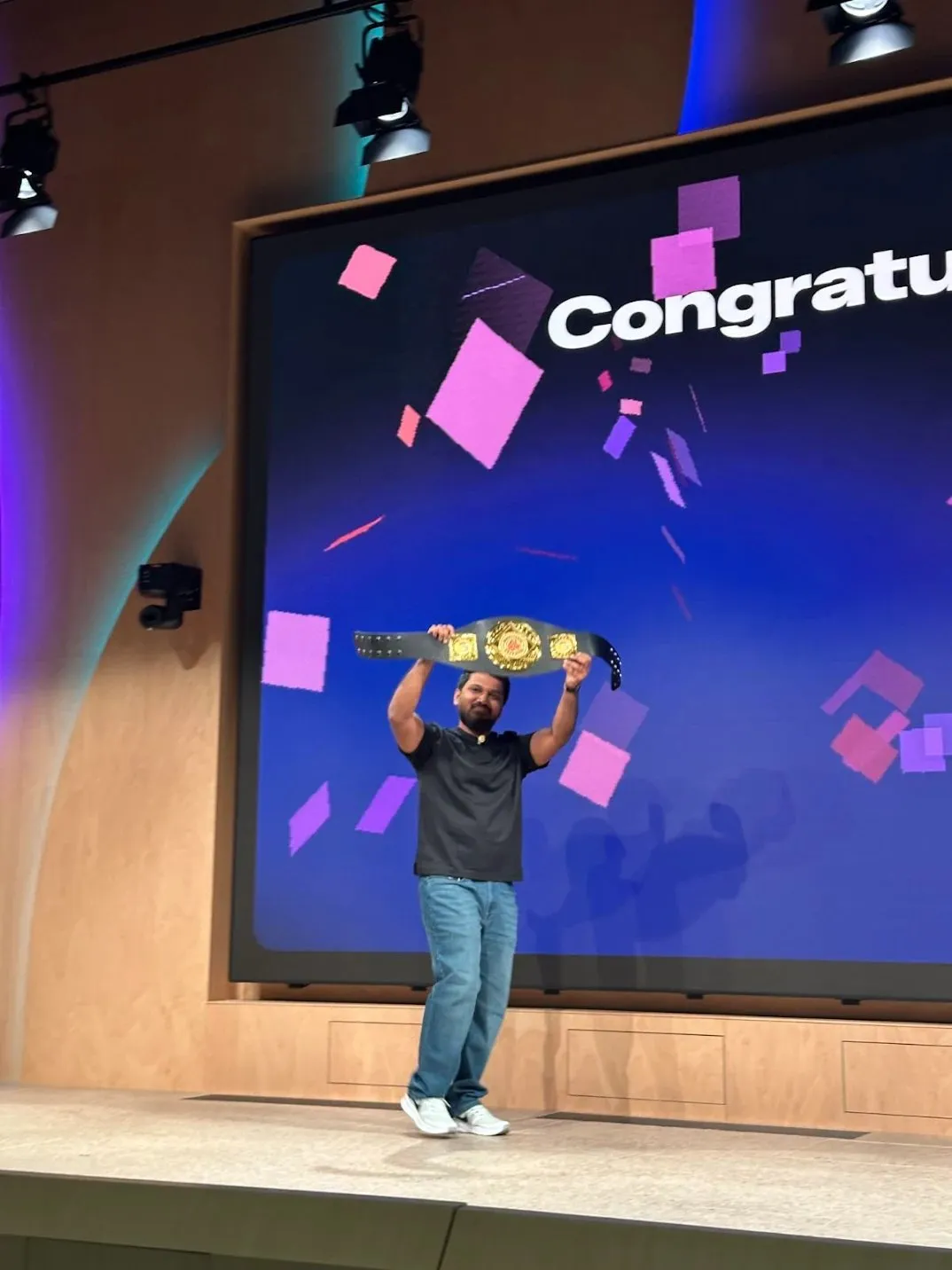
- 8,000+ Googlers upskilled across 10+ product areas so far; the agent-skills guide became the most-attended UX workshop of the year at Google, with 475 live at peak and 7,700+ users of its materials.
- My role
- I started the AI transformation work when there was no direction: author and point of contact on the program plan, proposer of the AI-native designer and agentic-tooling curriculums, personally teaching some. The 5am workshops were mine.
My job is tracking this space; I've tried the most tools and workflows at Google; my Google design class is the most-attended of the year. I'm here to make this accessible.
Context & constraints
The work before the work. I built an automated intelligence pipeline that's actually a piece of software. It started as answers to the questions that kept arriving: "I want to define the baseline role profile of an 'AI Native' designer." "I need to upskill my design team." "I need to quickly report on this latest tool release to inform build/buy decisions." The program formalized answering them into infrastructure.
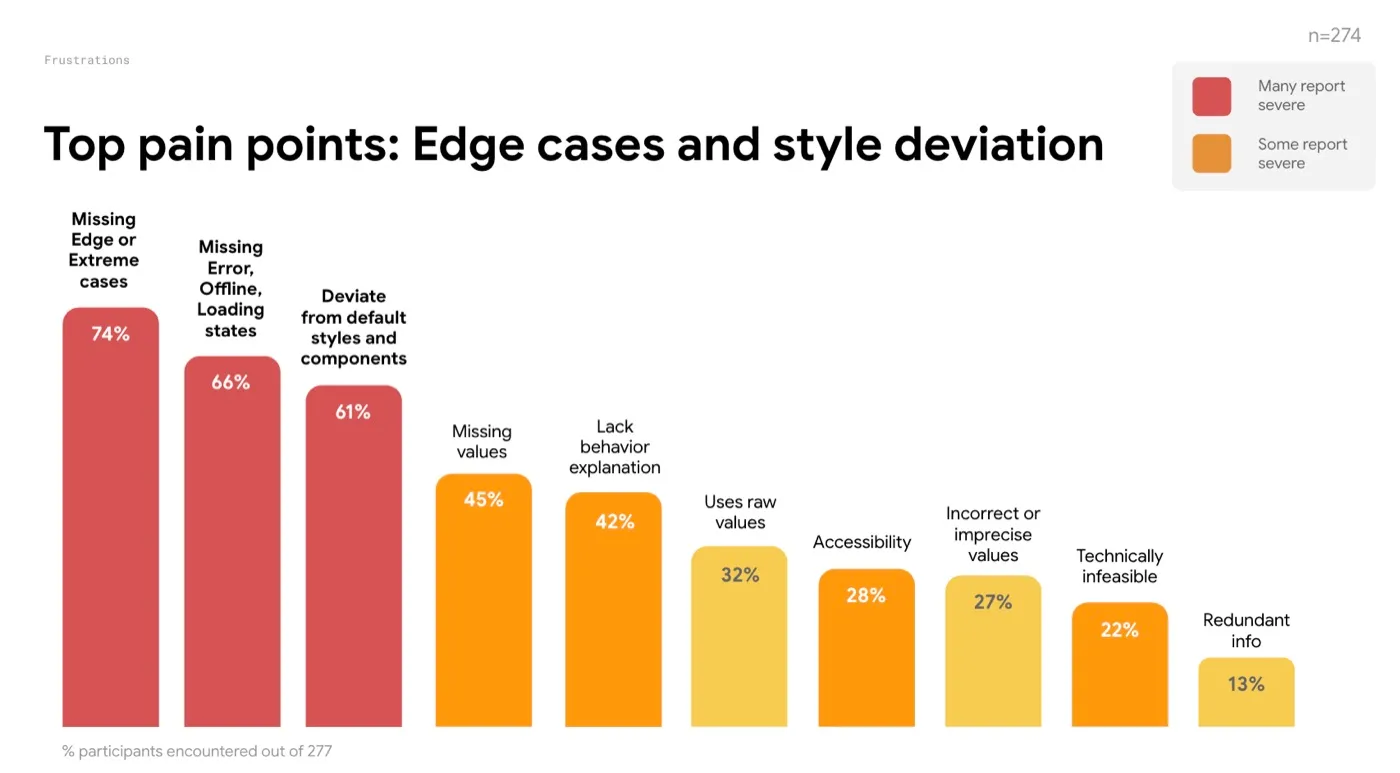
The constraints were structural, not incidental. Workflows change every week; info was getting redundant very quickly as AI's evolution upheaved our roles and processes; static reports are often obsolete by the time they are presented. Anything static was dead on arrival. And the audience's resistance was reasonable: the burden of verification, the last-mile problem, the context-switching tax, a lack of success stories. Respecting those reasons was a design requirement, not an obstacle.
And there was no mandate. Googlers deal with cumbersome infrastructure, approvals, and slide decks. One designer told us: "I don't have time to learn AI because I'm too busy launching AI features on Figma." After a reorg the program's resources were lost; I have been building some parts of this in my spare time.
Three decisions I pushed for
- 01
We build agent-readable knowledge bases, not new sites or apps
It was a deliberate decision to do it in docs, since that's agent-readable by the internal AI. A knowledge base extends to any form (tools, educational experiences, leadership insights) especially when integrated with existing agent standards. Scalable agent-readable knowledge bases can keep up with the pace of transformation.
What we didn't do: Another standalone site or app. People have tried AI news and resource apps to have "ownership": they aren't rewarded for docs, they are rewarded for new apps and "products." The cost of that path: a prettier artifact that no agent can read and no one maintains.
- 02
Human in the loop is still critical
Try it manually first, then slowly automate. Every report displays the actual source quotes right below the summary to prove it isn't hallucinated. Designers become the final judges of quality by managing agents and defining specs. And in the curriculum: review the plan as a HUMAN first; AI cannot substitute your creativity and judgment.
What we didn't do: The fully-automated pipeline. We tried it first: early attempts to completely generate a report suffered from hallucinations and noisy data. Shipping that to an already-skeptical org would have killed trust permanently.
- 03
AI education is grassroots. Lean on it.
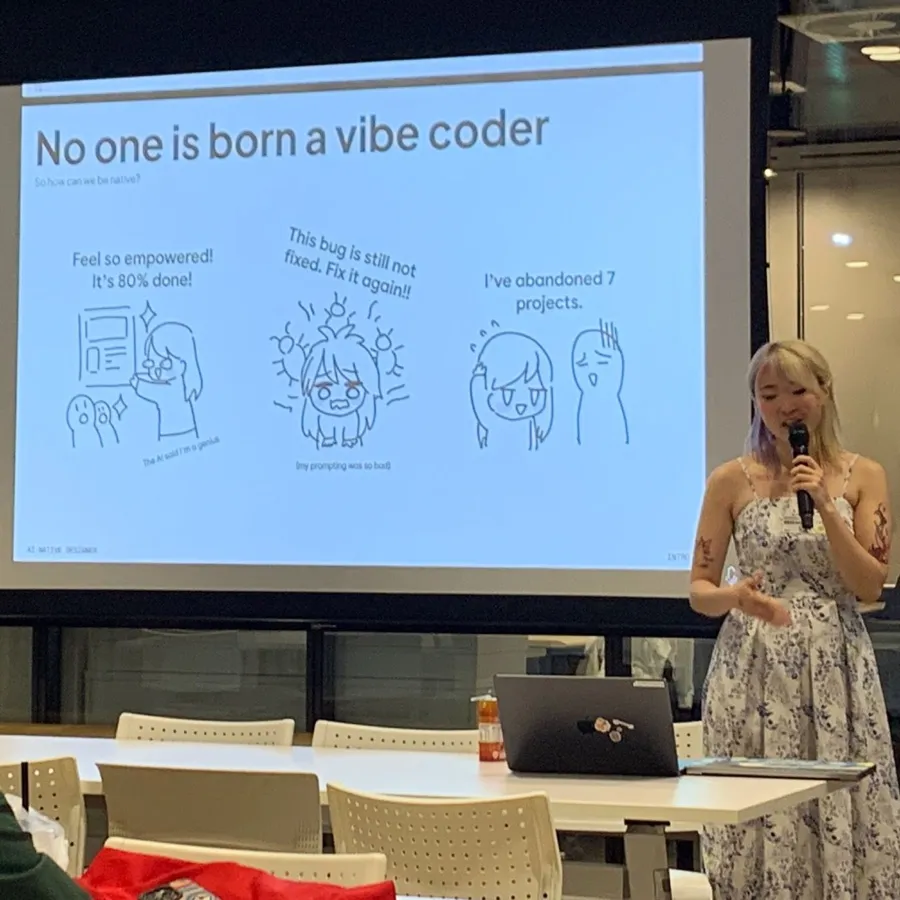
The best tutorials are visually rich, relatable, and create a safe space. Then people ask "I did X. Now what?" No one is born a vibe coder; it's OK to be anywhere along this journey. In the room it sounds like: don't worry, you don't start here; we're gonna get technical but don't be scared.
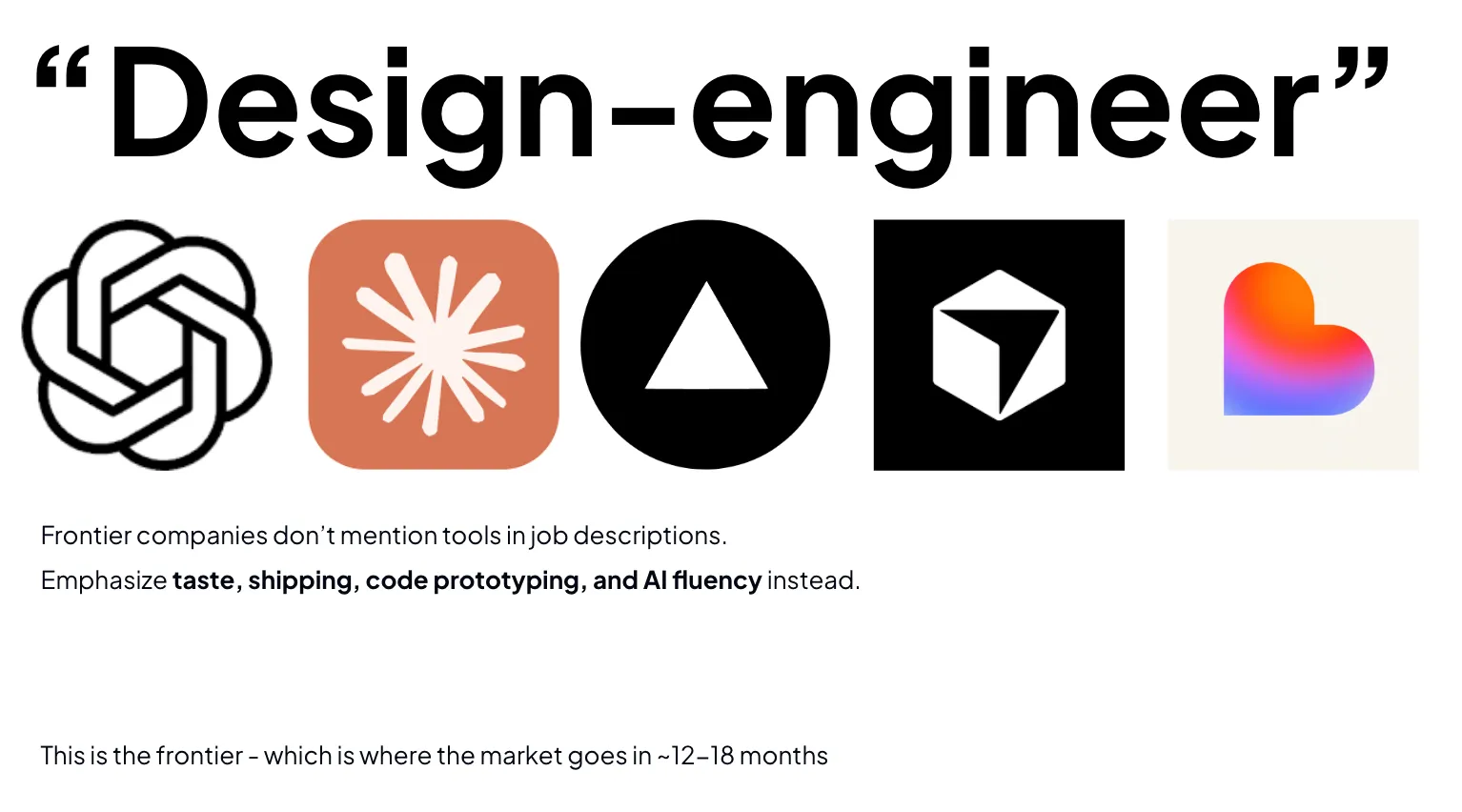
What we didn't do: Top-down expert lectures and sink-or-swim demos. Not everyone is meant to be a design-engineer; it's not about learning the tools, it's learning to ask. The cost of the lecture path: an anxious, visually-thinking audience checks out and the resistance never moves.
How I did it
The system: agents in, humans in the middle, capability out
Inputs: the agent fleet. We’re automating a data pipeline with agents. They scrape a range of sources daily: industry sentiment, expert opinions (Anthropic, OpenAI, Notion and more), state-of-industry reports, and dozens of internal channels. A lot of integrations and code went into getting agents to find the information and update docs every day, so everyone knows what’s going on with AI and where to find the latest vibe-coding kits.
Inputs: the human layer. We talked to 100+ designers, leaders, and vanguard practitioners across Google, Anthropic, Cursor and more. We asked across Google “Who’s the UX AI expert in your org?” and turned the answers into monthly discussions with knowledge distributed through the program. With UXR partners I co-ran a 13-person deep-dive study of designers’ real AI workflows (interviews plus screen recordings). Its headline: generative AI accelerates early-stage ideation, yielding up to a 4x velocity increase, but 100% of the cohort reverts to manual workflows for final handoff. That finding reshaped what we taught and what we asked of tooling. I also expanded the pipeline to analyze designers’ production-code contributions to track the design-engineer evolution. I predicted designers pushing production code and shared knowledge bases last year, before the industry caught up.
Outputs: reports that run themselves. Three automated report products on different cadences (daily resources, weekly tools news, weekly state-of-the-art), each grounded in the knowledge base and reviewed by humans. I iterated on the logic 50 times to make sure the quality was good, something no one else had been able to do, because it took a lot of patience and technicality. The weekly tools report has 2,300+ users, the resource repo is now the main way UXers find the latest AI resources, and leadership are using the insights to shape AI transformation strategy.
Outputs: education at scale. I proposed the AI-native designer and agentic-tooling curriculums, personally teaching some. The flagship “from idea to prototype” workshop moves through one connected workflow (research → grounded ideation → design → working prototype), ending in live demos. Presented five times to 1,500+ designers, then to over 10 orgs cross-functionally. A hands-on guide to agent skills for designers on Google’s internal code-based design tool became the most-attended UX workshop of the year at Google: 475 live at peak, 7,700+ users; the proposal and knowledge base were formalized into two org-level learning programs. The signature curriculum move: dialectical prompting. Force the LLM to process conflicting viewpoints, because even if you have a bad idea, AI tends to agree with you. Then the human gate: review the plan as a HUMAN first. Product sense is now the bottleneck.
“I’m returning from a 6 month+ mat leave … in 45 min, you’ve helped me ramp up so quickly. Truly, thank you from the bottom of my heart.” UX designer, Google
Outputs: steering the tools themselves. Backed by insights and UXR, I advocated for a designer version of Google’s internal code-based design tool to multiple product orgs, mapping the exact pain points designers were facing to tooling requirements; the tool’s team used the insights to prioritize and build a design mode and canvas integrations. The research said it plainly: we lost the canvas, we lost collaboration. Designers are bottlenecked by natural language to communicate their design intent. A future design tool would allow multi-agent orchestration, bring back visual manipulation, and support zero-handoff with code integration.
Outside Google, same mission
Outside, I run the vibe coders community in Tokyo and Singapore. Vibe Coders Tokyo (100+ people per session) keeps growing and is scaling to Singapore: nonprofit, tool-agnostic, peer-to-peer. Members demo their own builds, and contest champions teach the room their process. Conference talks and external classes carry the same myth-busting: born to design, forced to prompt. The workflow reveal: I don’t open the tools anymore. I direct one agent, an agent that lives inside my chat app and executes tasks. The claim I’ll defend on stage: demand isn’t dying, it’s compressing upward. AI has no stakes; AI cannot be accountable. And remember, English is now a programming language.
Impact
Leadership are using the insights to shape AI transformation strategy and operational shifts for their orgs. My agentic-tooling proposal and knowledge base were formalized into two org-level learning programs.
“Thanks to Xinni, I can save hundreds of hours and am better equipped to help 5,500 UXers!”
Elisa Sunga, Senior UX Program Manager, Google · permission pending
What broke / what I'd do differently
The fully-automated dream hallucinated
Early attempts to completely generate a report suffered from hallucinations and noisy data. In front of the function at Google most resistant of AI, that's fatal. The rebuild became decision 02: try it manually first, then slowly automate; display the actual source quotes below every summary. Next time I'd design the human gate in from day one instead of learning it from a bad report.
The last mile stayed manual, and I published that
Generative AI accelerates early-stage ideation (up to a 4x velocity increase in our 13-person study) but 100% of the cohort reverts to manual workflows for final handoff. Born to design, forced to prompt. That gap set the tooling agenda: multi-agent orchestration, bring back visual manipulation, zero-handoff with code integration. The capability story has a known ceiling I'd rather name than hide.
Training decays at the speed of the field
Tools evolve faster than official education can; as one vanguard designer put it, "the tools that served us for the last 10 years will not serve us for the next 10 months." And demand outran scope: 5 to 10 new pings every day from designers who found my tutorials and need more help. The durable fix was the knowledge-base principle: teach from living data, not decks. If I rebuilt this, I'd version the curriculum like software and staff past bus-factor-one. The 5am workshops were real.